Storefront Door Hinge and Pivot Repair Buffalo
Storefront Door Hinge and Pivot Repair Buffalo
Why hinge and pivot repair feels different in Buffalo’s winter and wind
Storefront doors in Buffalo and Western New York work in a harsher environment than most markets. Cold snaps drop below 20°F, which thickens hydraulic fluids and stresses every moving part. Lake-effect snow adds 95 to 100+ inches of accumulation most seasons. Foot traffic tracks road salt onto thresholds and into the bottom pivot pocket, the small recessed space in the floor that houses the lower pivot pin. Wind off Lake Erie pushes doors during opening and latching. All of this increases wear on the hinges and pivots that carry the door’s weight and keep it aligned.
A pivot hinge, which is the hardware that rotates an aluminum storefront door on a fixed pin at the top and bottom rather than on side-mounted butt hinges, is the first point of failure on many Buffalo storefronts. The bottom pivot takes the weight. The top pivot stabilizes the door and sets the alignment. An intermediate pivot, which is an extra support hinge mounted between the top and bottom on taller doors, spreads the load on doors above roughly 7 feet 6 inches. When salt, ice, or misalignment wear out these bearings and pins, the door sags, drags, binds, or hits the frame.
On Elmwood Avenue and Hertel Avenue, it is common to see narrow stile aluminum doors. A narrow stile door has 2-1/8 inch vertical edges, which leaves limited room for hardware. That places more stress on the pivot set and the top pivot adjustment. In Cheektowaga and Amherst plazas, medium and wide stile doors are more common, but they still use offset pivot systems that must be aligned precisely to close and latch against the weather. The same patterns show from Downtown Buffalo 14202 to the Medical Corridor 14203 and South Buffalo 14220. The local weather does not give these doors a break.
What fails on storefront pivots and how the failure shows up
When a storefront door starts to rub the threshold, catch the frame head, or feel rough during swing, the cause is usually in the pivot set. The bottom pivot bearing, which is the sealed bearing that the door rotates on at floor level, corrodes when salt and meltwater collect in the pivot pocket. The top pivot, which is a small adjustable pin and bushing at the head of the door, can loosen or shift under repeated load. If the door is tall and missing an intermediate pivot, the top and bottom pivots take more twisting than they were designed for, which speeds up wear.
Another factor in Buffalo is ice buildup in the floor pocket. When meltwater refreezes overnight, the ice pushes on the bottom pivot shoe and can bend it. That misaligns the vertical centerline of the door relative to the frame. The door then drags the threshold or hits the jamb at the latch side. If a hydraulic door closer on the header is fighting misalignment, it will slam or stall and then leak oil. The closer is often blamed, but the pivot geometry is the real problem.
Offset pivot hinge systems are standard on aluminum storefront doors from Kawneer, Tubelite, YKK AP, Vistawall, and US Aluminum. Offset means the pivot point is set a small distance, often 3/4 inch, away from the face of the door. This offset clears the frame and allows the door to swing properly. If the offset components wear or loosen, the door centerline shifts, which changes how the latch meets the strike. That is why a sagging door so often comes with a lock that will not latch cleanly.
Buffalo storefront door types and pivot hardware that matter to repair
Most retail, restaurant, and office entries across Erie County use aluminum storefront doors with stile and rail construction. The stile is the vertical edge of the door. Narrow stile is 2-1/8 inches, medium stile is 3-1/2 inches, and wide stile is storefront door repair Buffalo, NY 5 inches. Narrow stile doors, such as the Kawneer 190 series common in mid-century plazas, use compact pivot hardware. That hardware has less metal around it, so the adjustments must be precise. Medium and wide stile doors can accept heavier-duty pivot sets and are better suited for very high traffic or wind-prone entries on Transit Road, Niagara Falls Boulevard, and Walden Avenue.
On brand specifics, common pivot sets include the Kawneer TH1118 top and repairing storefront doors in Buffalo bottom offset pivot set and the Kawneer 050331 intermediate pivot for taller doors. Equivalent pivot sets exist for Tubelite T14000 and T24000 series and for YKK AP YES 45 and YES 60 storefronts. Very heavy entrances, such as those near KeyBank Center during an event or entries facing sustained wind at Canalside, may benefit from Rixson floor-mounted pivot systems. A floor-mounted concealed pivot is a heavier bearing system recessed into the floor that carries more load and resists wind-induced twisting better than surface-mounted hardware.
In restaurants and quick service sites from Orchard Park 14127 to Hamburg 14075, foot traffic spikes during peaks. Door cycle counts, which are the open and close operations per day, often reach 500 to 3,000 cycles on weekends. That load breaks down pivot bearings. A conservative Buffalo planning rule is to budget pivot service every 3 to 7 years on entries in those ranges, faster if the door faces prevailing wind or sits over a salty sidewalk. That is a higher wear rate than calmer-climate markets.
How hinge and pivot repair is performed without removing the whole storefront
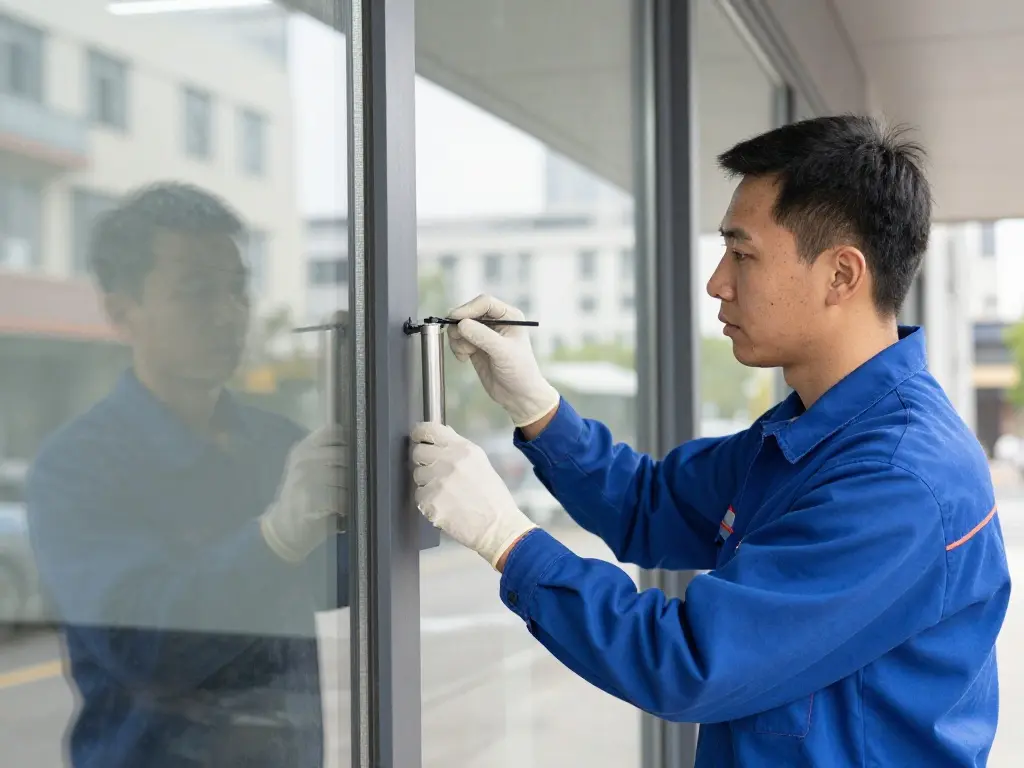
Most storefront hinge and pivot repairs do not require removing the entire door frame or glass wall. The door is removed from the opening, the pivot hardware is replaced or rebuilt, and the door is re-hung and aligned. The bottom pivot shoe, which is the floor-side bracket with a bearing and pin, is checked for pocket corrosion and for square alignment to the header. The top pivot spindle, which is the adjustable pin that engages the top pivot bushing, is set to bring the door plumb and level. The goal is simple: the door swings freely, clears the threshold, hits the stop evenly, and latches smoothly with the least closer force.
Aluminum storefront doors use through-bolts and reinforcement plates to secure the pivot leaf inside the stile. On older narrow stile doors, those plates can loosen or strip. A proper repair includes checking the reinforcement and replacing stripped screws with correct machine screws matched to factory thread patterns. On doors that have spent decades on Main Street or Grant Street, improvised wood screws are common. Those should be removed and replaced with proper hardware so the pivot adjustment holds.
If the door is above 7 feet 6 inches and does not have an intermediate pivot, adding one reduces torsion on the stile. An intermediate pivot, which is a mid-height hinge that shares load across the door, also reduces chatter and side play that cause lock misalignment. On glass-heavy entries with minimal frame members, a continuous geared hinge might be an alternative, but most Buffalo aluminum storefronts perform best when returned to a factory-style offset pivot set with correct handing. Handing means left-hand or right-hand when viewed from the exterior. Getting handing wrong causes part mismatch and wastes a trip.
Closers, locks, and glass alignment always tie back to pivot geometry
Door closers, which are spring and hydraulic devices that control the speed of closing, are sensitive to misalignment. In Buffalo, when temperatures fall below 20°F, the hydraulic fluid inside a closer thickens and loses smooth control. If the door is out of square because of pivot wear, the closer has to push harder. That forces seals and can cause oil leaks. It is why many slamming door calls in January turn into pivot adjustments and bottom bearing replacements. Surface-mounted closers like the LCN 4040 or Norton 8000 series, and concealed overhead closers like the Dorma RTS88, last longer when pivots are tight and aligned.
Lock work also depends on the door hanging true. Adams Rite narrow stile deadbolts and deadlatches mount in the thin stile and set on a precise backset. A sagging door will not bring the latch into the strike opening, and the user will feel a drag or a need to lift the handle. On panic hardware such as Von Duprin 98 series devices on small assemblies in Williamsville 14221, a door that hits the head or drags the threshold will not retract and latch as designed. That raises an NFPA 101 Life Safety Code concern. The solution often begins with pivots, not with the lock.
Glass is rarely the culprit, but a mis-hung door can stress tempered glass edges. Tempered glass, which is heat-strengthened safety glass per ASTM C1048, is strong in the center but vulnerable to edge pressure. A dragging or twisted door can chip an edge and lead to a later break. Proper pivot repair protects hardware and glass at the same time.
Buffalo’s cycle counts, salt, and wind create a predictable hinge maintenance pattern
On Elmwood Village and Allentown storefronts, usage peaks during events and weekends. That drives cycle counts and accelerates wear on bottom bearings. Sidewalk salt migrates into the pivot pocket. It dries on the bearing and pulls moisture from the air, which keeps the pocket damp. The bearing corrodes and grinds. In Cheektowaga 14225 plazas and Amherst 14228 office parks, snow removal pushes piles against entries, and meltwater flows into pockets during the day and refreezes at night.
Two simple Buffalo realities create a proven maintenance window. First, cold thickens lubricants and brings hidden play to the surface. Second, fall service just before the first freeze produces outsized returns because it resets pivots, replaces bearings before winter, and sets closers to work with the door, not against it. Local facilities that schedule fall pivot and closer service report fewer emergency visits during January storms. That is a budget line worth defending.
A shareable number for property managers: proactive offset pivot replacement on a narrow or medium stile door in Buffalo usually runs about $150 to $450 per pivot set during normal hours, depending on brand and door condition. After-hours emergency replacement can run 50 to 100 percent more. If the door fails open and glass cracks during business hours, add board-up and return trip costs. In other words, a pre-winter planned pivot service is one of the lowest-cost ways to avoid a mid-season emergency and a lost day of trading.
Aluminum storefront brands seen across Erie County and what their pivots ask for
Buffalo retail and restaurant stock leans hard to Kawneer, Tubelite, YKK AP, and legacy Vistawall and US Aluminum systems. Kawneer Trifab frames surround many entries in Downtown 14202 and along Chippewa Street. Tubelite T14000 and T24000 are common in strip plazas across West Seneca 14224 and Depew 14043. YKK AP YES 45 and YES 60 show up in newer mixed-use on Niagara Street and in Amherst near the I-990 corridor. Hardware from one brand usually swaps to another if sizing matches, but correct matching of pivot offset and handing avoids on-site modification.
For Kawneer doors, the TH1118 offset top and bottom pivot set and 050331 intermediate pivot cover most needs. Equivalent YKK AP and Tubelite sets are stocked on most professional service trucks in Western New York. On very tall or heavy entrances, a Rixson floor-mounted concealed pivot adds bearing capacity and stability. Floor closers from Rixson also appear on some older installations in the Theatre District. Those systems benefit from local technicians who know how to align a floor spindle, seal the case, and keep brine out of the cavity.
On high-traffic medical offices around the Buffalo Niagara Medical Campus in 14203, automatic swing door operators sit above the door. These are power-assisted devices controlled by sensors. Even with automatic operators, pivot alignment still matters. AAADM, the American Association of Automatic Door Manufacturers, requires that automatic door systems close and latch safely under ANSI A156.19 for swing doors. Poor pivot alignment creates unsafe forces and inconsistent closing speeds, which can fail an AAADM inspection. A stable pivot set is step one before sensor and operator adjustments.
Weatherstripping, thresholds, and the way they affect hinge life
Weatherstripping and thresholds exist to seal out air, water, and dirt. In Buffalo’s cool-humid climate, these parts also protect the pivot pocket. A torn EPDM bulb gasket, which is the soft tube-like seal on the frame, lets meltwater in and keeps the pocket wet. A worn door sweep, which is the strip at the bottom of the door, lets grit ride in under the door and into the bearing. Corroded aluminum thresholds warp and lift, which turns a straight, aligned door into a dragging door. A pivot set working against a bent threshold will fail early, even if the hardware was new.
The right repair plan includes checking the threshold for corrosion and slope, replacing damaged sweeps, and resetting the strike on Adams Rite deadlatches after pivot alignment. These steps ensure the closer does not fight a high spot and the latch does not bind. It is a small set of details that separate a quick fix from a complete, lasting storefront repair in Buffalo.
Response time and stocked-truck model that favors single-visit pivot repair
Hinge and pivot failures hit businesses at the worst times. A door that will not close on a windy Friday night in the Theatre District cannot wait for parts in the mail. A door that jams at opening time in Tonawanda 14150 needs attention fast so customers can get inside. The most effective repair model in Buffalo is built around direct dispatch and stocked trucks.
Service trucks that carry common offset pivot sets for Kawneer, Tubelite, YKK AP, and legacy Vistawall doors, along with intermediate pivots, reinforcement plates, fasteners, and cutting tools, turn most hinge and pivot calls into single-visit repairs. The same truck should carry LCN 4040 and Norton 1600 or 8000 series closers, Adams Rite MS1850 deadbolts and 4510 paddles, EPDM bulb gaskets, door sweeps, and aluminum thresholds. A door down on Elmwood Village or in Larkinville usually cannot afford a diagnose-now, return-later plan. A repair-first inventory saves a trip and gets the door back online the same day.
For emergencies across Buffalo city, a within-the-hour response is standard for a professional storefront company, with outer suburb response to Cheektowaga 14225, Amherst 14228, Williamsville 14221, Hamburg 14075, Orchard Park 14127, and West Seneca 14224 typically within two hours. After a break-in or impact event, temporary board-up with 1/2 inch plywood or 7/16 inch OSB secures the opening while hardware and glass are prepared. That workflow is common on Main Street Amherst and along Transit Road, where traffic incidents can take out a door overnight.
Cost ranges, scope, and how Buffalo property managers plan hinge work
Scope depends on door size, traffic, brand, and condition of the stile reinforcement. For a standard aluminum storefront door, a bottom pivot bearing replacement and top pivot reset is typically a short service call during regular hours. If the stile threads are stripped, more time and hardware go into proper fastening. If the threshold is warped or the closer is leaking oil, those items can be added to the same visit to avoid repeat downtime.
On costs, Buffalo market ranges are consistent with other Great Lakes cities. Planned offset pivot replacement during normal hours generally falls between $150 and $450 per pivot set, with intermediate pivot adds on taller doors. If a repair requires overnight dispatch or adds emergency board-up after glass damage, labor premiums of 50 to 100 percent apply. A continuous geared hinge, which is a full-length hinge sometimes used as a retrofit on doors with damaged stile reinforcement, costs more in material and is not usually the first choice on aluminum storefronts that were built for offset pivots. Most Buffalo entries perform best when restored to factory pivot geometry with matched brand hardware.
Property teams with multiple doors on corridors like Elmwood Avenue, Hertel Avenue, and Main Street plan hinge and closer work in bundles to minimize travel time and ensure even wear conditions across doors. A common pattern is a fall pre-winter service visit in September or October, with a spring check where cycle counts are high. This is especially valuable for shopping centers in Cheektowaga and Amherst where entries face wind tunnels created by long façades and open parking fields that funnel wind off Lake Erie.
What success looks like after a professional pivot and hinge repair
A well-repaired pivot system makes itself known in small ways. The door opens with light, even resistance and closes cleanly against the stop without a slam. The latch meets the strike without needing to lift the handle. The sweep just kisses the threshold without scraping. The deadbolt throws fully on Adams Rite MS1850 locks because the backset is aligned. The closer sweep speed and latch speed can be set to match ADA force expectations, which for interior doors means about 5 pounds of opening force and reasonable closing times under ADA guidance. Exterior doors that face weather can require more force, but the goal is always a safe, predictable motion that meets New York State and local code expectations for egress and accessibility.
From a maintenance perspective, a technician should be able to return on the next cycle and find pivot adjustments still tight. That means reinforcement plates were inspected, fasteners were correct, and the pivot pocket was cleaned and, where needed, sealed from chronic water intrusion. In Buffalo, adding a simple drain path from the pivot pocket can extend bearing life through winter. If the installation faces persistent ice due to roof drip, a minor gutter or diverter above the entry can make a large difference in long-term hardware life.
Where hinge and pivot repair shows the biggest return in Western New York
In the Downtown Buffalo 14202 office towers and retail ground floors, door sets cycle thousands of times and face wind off Main Street and the waterfront. Small misalignments become tenant complaints and access issues. In the Buffalo Niagara Medical Campus 14203, automatic swing doors depend on pivot geometry to pass AAADM checks under ANSI A156.19. In the Amherst 14228 and Williamsville 14221 office parks, narrow stile doors with tired pivots pull closers past their limits and generate leaks during cold stretches. In South Buffalo 14220 and Lackawanna 14218, salt-heavy sidewalks chew through bottom bearings unless thresholds and sweeps are maintained.
The consistent pattern is simple. Doors that sit near parking lot plow paths, face long fetch winds, or see high cycle counts benefit most from a professional pivot service plan. Property managers who treat pivots as wear parts save money on closers, locks, and glass over time. This is local, not theoretical. The climate and usage patterns across Buffalo and Erie County make hinge and pivot service a predictable, budgetable line item.
Neighborhood and corridor notes that help with dispatch and parts matching
Older brick storefronts along Grant Street and Allen Street often have retrofitted aluminum entries from the 1970s to 1990s. Expect legacy Vistawall or US Aluminum components and mixed hardware. Matching a Kawneer TH1118 or a Tubelite set by measurement rather than by label speeds repair. In Elmwood Village 14222 and North Park 14216, narrow stile entries are common, which increases the odds that stile reinforcement needs attention. Along Transit Road and Niagara Falls Boulevard, heavier medium and wide stile doors appear, and wind load is higher, which makes intermediate pivots or heavier pivot sets smart upgrades.
At Buffalo Niagara International Airport in Cheektowaga 14225 and near large athletic events in Orchard Park 14127, higher security expectations often add panic bars or electric strikes. Rim exit devices like the Von Duprin 98/99 series mount on the door face and expect square alignment to latch. Misaligned pivots can cause these devices to false latch or pop open under wind. A competent hinge and pivot repair restores the geometry these devices rely on and keeps entries safe under NFPA 101 and IBC Chapter 10 egress provisions.
Why hinge and pivot repair should be handled by a Buffalo storefront specialist
Offset pivot systems are simple to look at but unforgiving of guesswork. The adjustment threads are small. The clearances are tight. The stile reinforcement can hold or can be stripped. Floor pockets can be square or can be twisted by decades of settlement on historic Main Street properties. A repair that starts with the wrong handing, an incorrect offset, or a forced fit makes alignment impossible and sets up repeat failures.
A specialist who works storefront doors every day knows the difference between a pivot problem and a frame racking problem. Frame racking, which is a shift in the frame due to building movement, shows up as unequal reveals. A skilled technician can read those reveals and decide whether to shim the frame, adjust the pivots, or do both. That is the field judgment that keeps a Buffalo storefront running through wind, cold, and heavy traffic.
Response coverage across Buffalo and Western New York
Hinge and pivot calls come from all over the city and suburbs. Coverage extends across Buffalo neighborhoods including Elmwood Village 14222, Allentown 14201, Delaware District 14209, West Side 14213, University District 14215, Larkinville and Hydraulics near 14203, and Broadway-Fillmore near 14206 and 14204. Suburban coverage includes Cheektowaga 14225, Amherst 14228, Tonawanda 14150, North Tonawanda 14120, Kenmore 14217, Lackawanna 14218, West Seneca 14224, Hamburg 14075, Orchard Park 14127, Williamsville 14221, Clarence Center 14031, Depew 14043, Lancaster 14086, East Aurora 14052, and beyond into Niagara County.
Busy commercial corridors like Main Street Amherst, Sheridan Drive, Maple Road, Niagara Falls Boulevard, Walden Avenue, McKinley Parkway, and the I-90 and I-190 corridors see frequent service calls during peak retail seasons. Knowing these areas and their building archetypes shortens diagnosis time and helps technicians arrive with the right hardware the first time.
Why Buffalo businesses call A-24 Hour Door National Inc. For storefront hinge and pivot repair
A-24 Hour Door National Inc. Operates from 344 Sycamore Street, Buffalo, NY 14204, central to the Broadway-Fillmore and Downtown service zones. The company dispatches local technicians directly rather than routing through a call center. Trucks carry common Kawneer TH1118 pivot sets, 050331 intermediate pivots, Tubelite and YKK AP equivalents, LCN 4040 and Norton 1600/8000 closers, Adams Rite MS1850 deadbolts and 4510 paddles, EPDM bulb gaskets, sweeps, thresholds, and board-up materials. That stocked-truck model completes most storefront hinge and pivot repairs in a single visit across Buffalo, Cheektowaga, West Seneca, Hamburg, Orchard Park, Amherst, Tonawanda, and Williamsville.
For automatic door entries, AAADM-certified technicians handle inspections and repairs under ANSI A156.10 for sliding doors and ANSI A156.19 for swing doors. Even on automatic systems, proper pivot alignment is part of the service so operators do not fight geometry. The company is fully insured as a New York State commercial contractor and has factory familiarity across Kawneer, Tubelite, YKK AP, Vistawall, US Aluminum, Ellison Bronze balanced doors, and related hardware brands including Von Duprin, Sargent, Dorma, Norton, and LCN.
Buffalo city emergency response typically arrives within the hour. Outer suburb response usually arrives within two hours. After break-in or storm damage, emergency board-up is available 24/7 with next-day glass measured and installed on common sizes. Preventive maintenance programs prioritize a fall pre-winter visit because Buffalo’s below-20°F temperatures thicken closer fluid and expose any pivot play. That visit reduces winter emergency calls and extends closer and pivot life across multi-site portfolios.
For immediate storefront door hinge and pivot repair in Buffalo, NY, call +1-716-894-2000. A-24 Hour Door National Inc. Schedules same-day hinge and pivot service across Buffalo and Western New York, and dispatches 24/7 for emergencies that threaten security or operations. Service pages and contact options are available at https://a24hour.biz/services/storefront-doors/storefront-door-repair-buffalo-ny/.
A-24 Hour Door National Inc provides commercial and residential door repair in Buffalo, NY. Our technicians service and replace a wide range of entry systems, including automatic business doors, hollow metal frames, storefront entrances, fire-rated steel and wood doors, and both sectional and rolling steel garage doors. We’re available 24/7, including holidays, to deliver emergency repairs and keep your property secure. Our service trucks arrive fully stocked with hardware, tools, and replacement parts to minimize downtime and restore safe, reliable access. Whether you need a new door installed or fast repair to get your business back up and running, our team is ready to help. A-24 Hour Door National Inc
344 Sycamore St Phone: (716) 894-2000 Website: https://a24hour.biz/buffalo
Instagram: @a24hourdoor
Buffalo,
NY
14204,
USA
Facebook: 24 Hour Door
Yelp: A-24 Hour Door National (Buffalo)
X (Twitter): @a24hrdoor